Wellbeing Is a Regulatory System
A neuroscience-based framework for how
behavior builds biology
Wellbeing is often treated as a mood, a mindset, or a collection of good habits. I approach it differently.
Wellbeing is a regulatory achievement.
It emerges from how effectively the brain and body coordinate across multiple systems—neural, autonomic, endocrine, immune, metabolic—to maintain stability in the face of stress and change. It is not just how you feel. It is how well your internal systems are calibrated.
This page outlines the framework that guides my work.
The Core Claim
Behavior is not just the result of biology.
Behavior is an input into biology.
Everyday actions—sleep, movement, nutrition, breathing patterns, attention, social connection, digital habits—send regulatory signals into an integrated brain–body network. That network interprets those signals and adjusts physiological state accordingly.
Over time, repeated behaviors shape the system itself.
Neural pathways are strengthened or weakened.
Stress reactivity is tuned up or down.
Inflammatory tone shifts.
Metabolic flexibility improves—or erodes.
In short: Behavior builds biology.
The Model
This framework centers on three interacting components:
Behavior
Integrated Brain–Body Network
Physiological State
Behavior feeds into the integrated brain–body network—the distributed system linking cortical and subcortical circuits with autonomic, endocrine, immune, and metabolic processes. This network regulates physiological state moment to moment.
Physiological state then shapes perception, cognition, emotion, motivation, and future behavior.
Repeated behavior engages adaptation, plasticity, in brain & body.
All arrows are bidirectional. This is not a linear pipeline. It is a feedback loop. Which you can strongly influence.
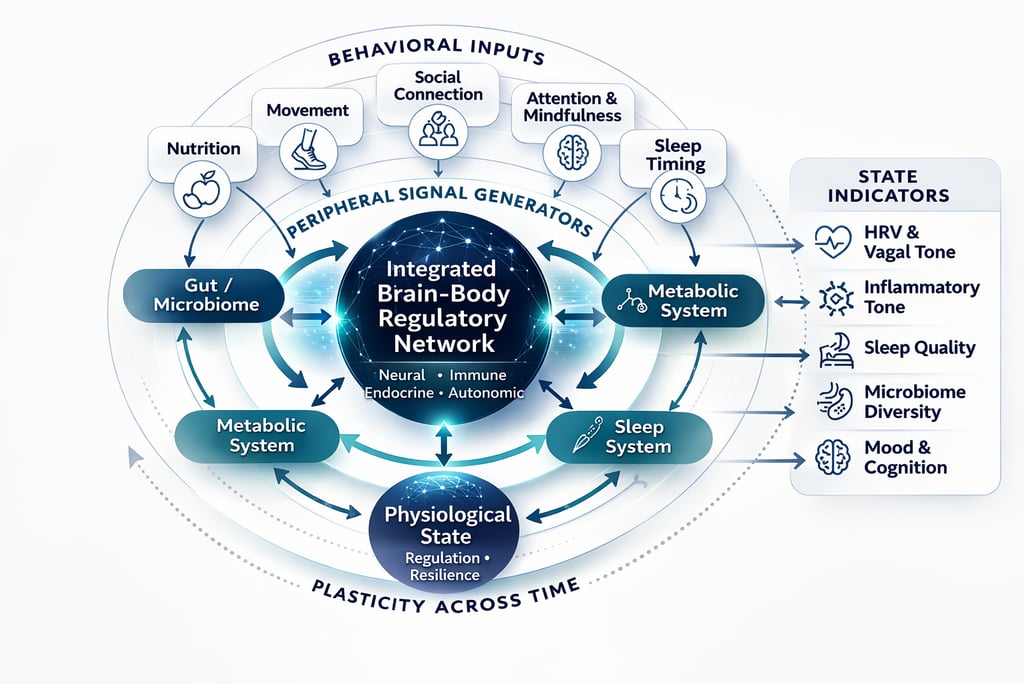
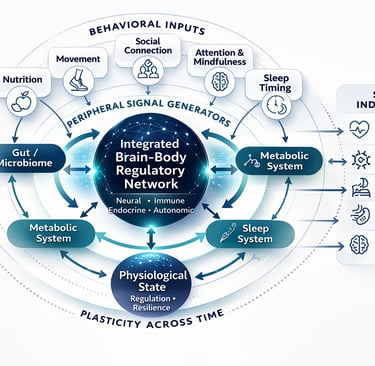
A systems model of wellbeing. Behavior feeds into an integrated brain–body network that regulates physiological state. Physiological state, in turn, shapes perception, cognition, emotion, and future behavior. All arrows are bidirectional: this is a dynamic regulatory system, not a linear sequence. Neural plasticity enables repeated behaviors to rewire the brain body system. Image generated in collaboration with ChatGPT.
Why This Matters
Most wellbeing advice treats behaviors as isolated habits.
Most mental health conversations isolate the mind from the body.
Most physical health models ignore cognition and emotion.
This framework refuses those separations.
It treats the human organism as a dynamically regulated system. It emphasizes leverage points—behaviors that measurably influence autonomic balance, neural plasticity, inflammatory signaling, and stress resilience.
It also clarifies why small changes compound. In feedback systems, repeated inputs alter set points. The system stabilizes around what it practices.
That is why understanding the biology and psychology of change and adaption matters.
Wellbeing, in this view, is not a trait you either possess or lack. It is a capacity that can be strengthened through repeated regulatory inputs over time.
How I Use This Framework
This model guides how I:
Interpret research in neuroscience and health science
Design educational materials and interventions
Think about resilience, stress, and recovery
Evaluate which behaviors have outsized biological impact
It also shapes how I collaborate—with clinicians, educators, organizations, and individuals who want to move beyond slogans, simplistic "fixes" or "hacks", and into evidence-based mechanisms based on cutting edge insights from neuroscience.
Because when you understand the mechanisms, you gain leverage.
And leverage is what turns information into transformation.